Essential cookies enable core functionality. The website cannot function properly without these cookies, and they can only be disabled by changing your browser preferences.
Advertisement cookies are used to provide visitors with relevant ads and marketing campaigns. These cookies track visitors across websites and collect information to provide customized ads.
Used to identify individual clients behind a shared IP address and apply security settings on a per-client basis.
By selecting “Accept all” you allow QualityHive and our partners to use cookies and to share your data for all these purposes.
We and our partners use cookies and similar tools to measure our site's audience, evaluate the performance of our ads, and show you personalized content and ads.
Except for cookies that are essential for navigating our site, we use these cookies and share your data only with your consent.
Automate client feedback with our MCP serverLearn more!
The best website annotation tool depends on what you are marking up. For live websites where comments become fixes, shortlist QualityHive, BugHerd, Marker.io or Feedbucket. For client sign-off on PDFs, images and designs, shortlist Pastel, zipBoard, Filestage, Markup Hero or Figma.
QualityHive is our own product, so read that entry with that in mind. Every price below was checked on the vendor's own pricing page in November 2026, on monthly billing unless stated, and these pages change often.
Live sites and static files need different tools
Annotation tools fall into two camps, and picking from the wrong one is the most common mistake.
Live website tools work on the real page in a browser. A reviewer clicks a menu, a form or a button, and the comment is pinned to that element. Because the page is running, these tools can usually record the browser and screen size too. They reach the page in one of three ways, and each has a trade-off:
A script on the site needs someone with access to add it.
A browser extension needs installing by whoever uses it.
A copy of the page loaded through the vendor needs no installation, but complex pages may not render perfectly and password-protected pages may need extra steps.
File annotation tools work on a fixed thing: a PDF, an image, a design file or a video. They are better for sign-off on artwork, documents and mock-ups, because the thing being approved does not change between reviewers.
Some products do both. Pastel, ruttl, MarkUp.io, zipBoard and Filestage all take websites and files, so we have listed each where it fits best.
The 12 tools at a glance
Prices are per month in the currency each vendor shows, at the time of writing (November 2026). Tool names link to each pricing page.
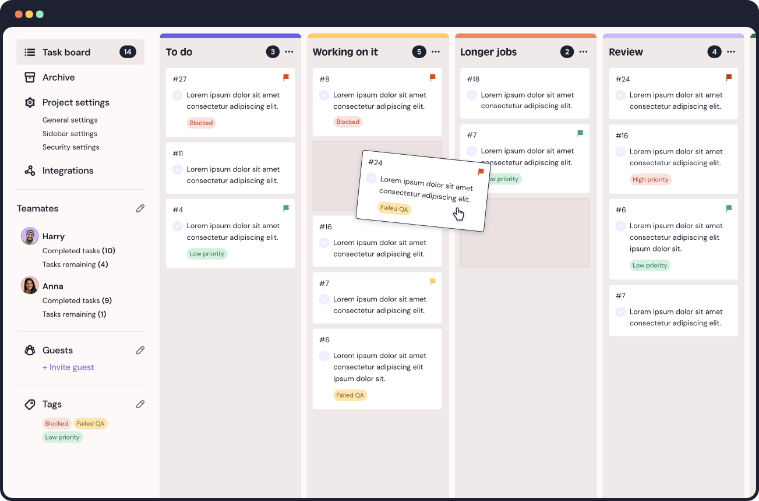
QualityHive is made for website feedback that ends with a developer. Add a script to the <head> or through Google Tag Manager, or use the Chrome, Firefox or Edge extension with no site changes. Someone clicks an element and a task is created with a screenshot and that element pinned, then it lands on a real-time Kanban board. Clients get one guest link with no login, on Lite at $18 a month or above. Direct integrations cover Trello and Monday.com only. Our website annotation tool page explains how it works.
BugHerd
BugHerd lets clients point, click and comment on a live site, with a screenshot and browser, OS and resolution details on each comment. It installs as a browser extension or JavaScript snippet, and staging or internal sites need the snippet. Standard is $50 a month for 5 members with unlimited guests. Jira, Asana and Monday.com need Premium at $150. Its homepage lists a 7-day free trial.
Marker.io
Marker.io is aimed at sending bug reports into developer tools, with console logs, network requests and session replay on Team and above. Install it with a snippet, WordPress plugin or Chrome extension. Starter is $59 a month for 3 members and up to 10 projects, and connects to Trello, Asana, ClickUp, GitHub, GitLab, Linear and Notion. Jira is on the $199 Team plan and the $129 Agency plan, which is for eligible agencies.
Save countless hours on your projects
Raise tasks in under 3 seconds using our revolutionary widget
Feedbucket
Feedbucket is for agencies that want client feedback inside the project tool they already use. Clients need no account or extension, and more than a dozen integrations, including Asana, Jira, ClickUp and Monday, are on every plan. Pro is $49 a month for 2 team members and Business is $89 for 25. There is a 14-day trial but no free plan listed. Our Feedbucket comparison goes through the trade-offs.
Pastel
Pastel creates a canvas from a URL, PDF, image or email and you share the link, with nothing to install and guests commenting without an account. It leans towards sign-off, with approvals and deadlines on every plan. Free covers 1 user and 1 active canvas. Pro is $35 for 2 users and 3 canvases, and comment export to project tools starts on Team at $119. Our Pastel comparison has the full table.
Atarim
Atarim began as a visual feedback tool and now describes itself as an AI agency. Pins, guest comments and WordPress or script installs are still there, alongside six AI specialists that edit and update client sites with your approval. Pro is $67 a month with up to 100 seats, and 5,000 monthly credits pay for the AI work. It suits agencies that want AI making the changes, and it is more than you need if you only want comments. Our Atarim comparison covers the differences.
ruttl
ruttl covers live websites, web apps, mobile apps, PDFs and images, with no sign-up for clients. The Basic plan is free for 1 project and 5 pages, and Pro is $18 per user per month. It lists connections to Trello, Slack, Asana, Jira, Zapier and ClickUp. Per-user pricing adds up on larger teams, so do the sum before you commit.
MarkUp.io
MarkUp.io lets you drop in a link and comment on a live site, or upload from more than 30 file types, with guests needing no registration. Pricing is based on volume instead of seats. Pro starts at $79 a month for 50 MarkUps with unlimited users, and extra MarkUps cost $4 each. That suits larger teams with a steady number of reviews.
Tools for annotating images, PDFs and design files
zipBoard
zipBoard is a review and approval tool for documents, drawings and courses, with SCORM and HTML ZIP uploads, version comparison and approvals per reviewer. It can review live URLs too. Team starts at $99 a month with unlimited collaborators and reviewers, and up to 20 content pieces. Our zipBoard comparison has the detail.
Filestage
Filestage is proofing software for reviewing and approving creative work, covering PDFs, images, video, audio, interactive HTML and websites. It logs each review decision and reviewers need no account. The Free plan covers 1 active project and 5 new files a month, and Starter is €199 a month. It is aimed at structured approval work, so it is more than most teams need for a quick page review.
Markup Hero
Markup Hero is the quick option for screenshots, uploaded images and PDFs, with arrows, text, blur and shareable links. It can screenshot a web page, but the markup sits on the image and not on the running site. Free is limited to 25 screenshots. Premium is $10 a month, or $3 a month billed annually.
Figma
If you are reviewing a design and not a built site, comments in Figma itself are often enough. You can pin a comment to a location or region on the canvas, and Figma's pricing page says you can invite unlimited viewers to view and comment for free. Professional seats start at $3 a month for a Collab seat and $16 for a Full seat. Its comments sit on design files and prototypes, so it is not a tool for reviewing a built site.
Pick this if...
You want bug reports developers can act on: QualityHive, BugHerd or Marker.io. Marker.io's Team plan adds console logs and network requests.
Your project tool decides it: Feedbucket lists more than a dozen project tools on every plan. If you are on Trello or Monday.com, QualityHive sends tasks to both from $18 a month.
You want free client review: Pastel's Free plan includes unlimited guests on one active canvas, and ruttl has a free one-project plan.
You sign off mixed creative work: Pastel or Filestage.
You review SCORM courses or technical documents: zipBoard.
You want AI to make the changes: Atarim, particularly on WordPress.
You only need to mark up a screenshot: Markup Hero.
You are reviewing designs before build: Figma.
What to test in your trial
Most of these tools have a free plan or trial, so run the same checks on your shortlist.
Your hardest page. Load the page with the most JavaScript, such as a checkout or a filtered product list, and check comments pin to the right element.
A real client. Send the link to someone who has not seen the tool and watch whether they can comment without help. Our guide on how to give website feedback is handy to send with it.
Your staging setup. Test behind the password or IP restriction you actually use, as tools that load a copy of the page may need extra steps.
Security headers. If your site sets strict X-Frame-Options or CSP headers, check any tool that loads the site in a frame. QualityHive's guest link is one of those, so those headers must allow app.qualityhive.com and connector.qualityhive.com.
One comment to done. Take a single comment from the client through to fixed and closed, and count how many places it passed through.
The bill at your real size. Count seats, projects, credits or content pieces at next year's team size, not today's.
Revolutionise your QA processes
FAQ
What is a website annotation tool?
A website annotation tool lets someone place comments or drawings directly on a web page, so feedback is attached to the element it refers to instead of being described in an email. Most also collect those comments into a list or board for whoever fixes them.
Can I annotate a website for free?
Yes, within limits. Pastel's Free plan covers one active canvas and ruttl's Basic plan covers one project. QualityHive's Free plan is one person and one project, so collecting client feedback through guest links needs Lite or above.
What is the difference between website annotation, visual feedback and design feedback tools?
Website annotation and visual feedback tools usually mean the same thing: comments placed on a working page. Design feedback tools usually work on mock-ups and files before a site exists. Some products span both, so check whether a tool accepts a URL or only uploads.
Do clients need an account to leave comments?
Usually not. Most of the live website tools here let guests comment without signing up, though some ask for an email address. Check how a tool handles guests during your trial, because a login prompt is an easy way to lose a busy client.