Essential cookies enable core functionality. The website cannot function properly without these cookies, and they can only be disabled by changing your browser preferences.
Advertisement cookies are used to provide visitors with relevant ads and marketing campaigns. These cookies track visitors across websites and collect information to provide customized ads.
Used to identify individual clients behind a shared IP address and apply security settings on a per-client basis.
By selecting “Accept all” you allow QualityHive and our partners to use cookies and to share your data for all these purposes.
We and our partners use cookies and similar tools to measure our site's audience, evaluate the performance of our ads, and show you personalized content and ads.
Except for cookies that are essential for navigating our site, we use these cookies and share your data only with your consent.
Automate client feedback with our MCP serverLearn more!
This website project plan template covers a full 12-week build, phase by phase, with every task, owner, duration and deliverable set out in two tables. Copy them into a spreadsheet, swap in your names and dates, and you have a working plan.
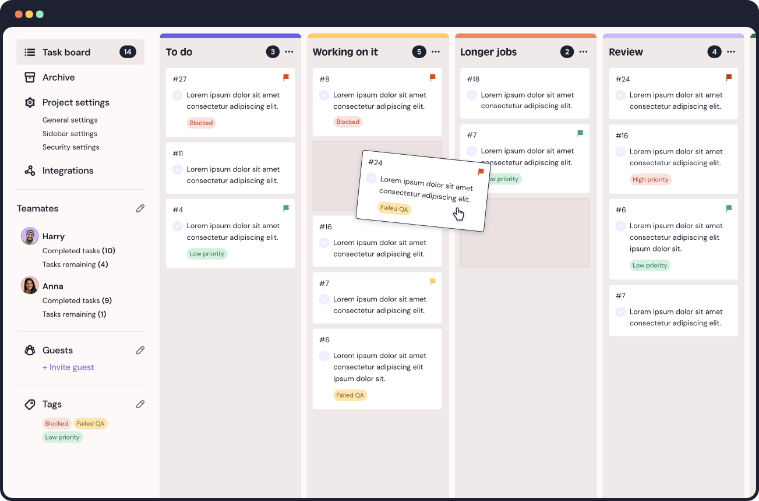
Weeks 10 and 11 are also when feedback gets messy. QualityHive keeps QA and UAT issues on one Kanban board, each with a screenshot and the exact element pinned, and the agency page shows how client guest links fit in.
Who signs what
Four gates hold the plan together. Work on the next phase should not start until the gate before it is signed.
Gate
End of
Signed by
What it locks
1
Week 2
Client lead
Scope and requirements
2
Week 4
Client lead
Wireframes and page list
3
Week 6
Client lead
Visual design
4
Week 11
Client lead
Approval to launch
Written sign-off can be an email reply, as long as it names the version being approved. Agree the number of revision rounds in the same conversation.
Check it against your budget
Adding up the two tables by role gives you a quick way to test the plan against the budget.
Role
Days in plan
When
Project manager
10
Mostly weeks 1, 2 and 12
Designer
15.5
Weeks 2 to 6
Developer
23
Weeks 7 to 12
QA tester
4.5
Weeks 10 and 12
Client lead
14
Review windows across the project
Content owner
28
Weeks 3 to 9
That is 53 agency days, plus around half a day a week for running the project. The client figures are elapsed time and not full-time effort, but the client still needs to know the time is coming. A content owner with a day job will not write 15 pages in a fortnight.
Adjusting the plan for other projects
Treat these as planning assumptions and check them against your own past projects.
Client reviews and copy tend to be what moves a website launch date, because the agency team cannot do anything about either. Put this in the plan from day one:
Schedule dependenciesThis plan assumes each client review is returned within theworking days shown. If a review is late, the launch date movesby at least the same number of working days.Changes requested after a gate has been signed are treated asnew requests and quoted separately.
When you have to recover time, cut scope first. Move Should and Could items to a second phase before you shorten QA or UAT, because defects found after launch cost more to fix and are seen by real customers.
If copy is late, launch with the finished pages and add the rest in phase 2. That is usually better than holding the whole site back for two service pages.
Risks to watch
Risk
Early warning
Response
Content is late
Under half written by week 6
Move pages to phase 2
Reviews drift
Feedback a day overdue
Move launch date in writing
Scope creep
New requests after Gate 1
Quote as a change
Too many reviewers
Conflicting feedback
Route through client lead
Integration blocked
No API access by week 6
Escalate to client lead
Key person away
Leave clashes with a gate
Name a deputy approver
Weekly status update
Send this every Friday. It takes five minutes and stops the "where are we?" emails.
Project: [Name] Week: [n] of 12Status: On track / At risk / LateDone this week:- [Item]Next week:- [Item]Waiting on you:- [Item] by [date]Launch date: [date]
Revolutionise your QA processes
FAQ
What should a website project plan include?
Phases, tasks, named owners, durations, deliverables, sign-off gates and the dependencies that move the launch date. A short risk list and a weekly status update keep it in use after week one.
How long should a website project take?
As a planning assumption, 12 weeks suits a 15-page marketing site with client feedback returned on time. A templated site can take less. E-commerce, integrations and migrations take longer.
Who should own the project plan?
The project manager. One person updates it, normally every Friday, so there is a single version everyone trusts.
What is the difference between a project plan and a requirements document?
A requirements document says what the finished site must do. The project plan says who does what, by when, and what has to be signed before the next phase starts.